
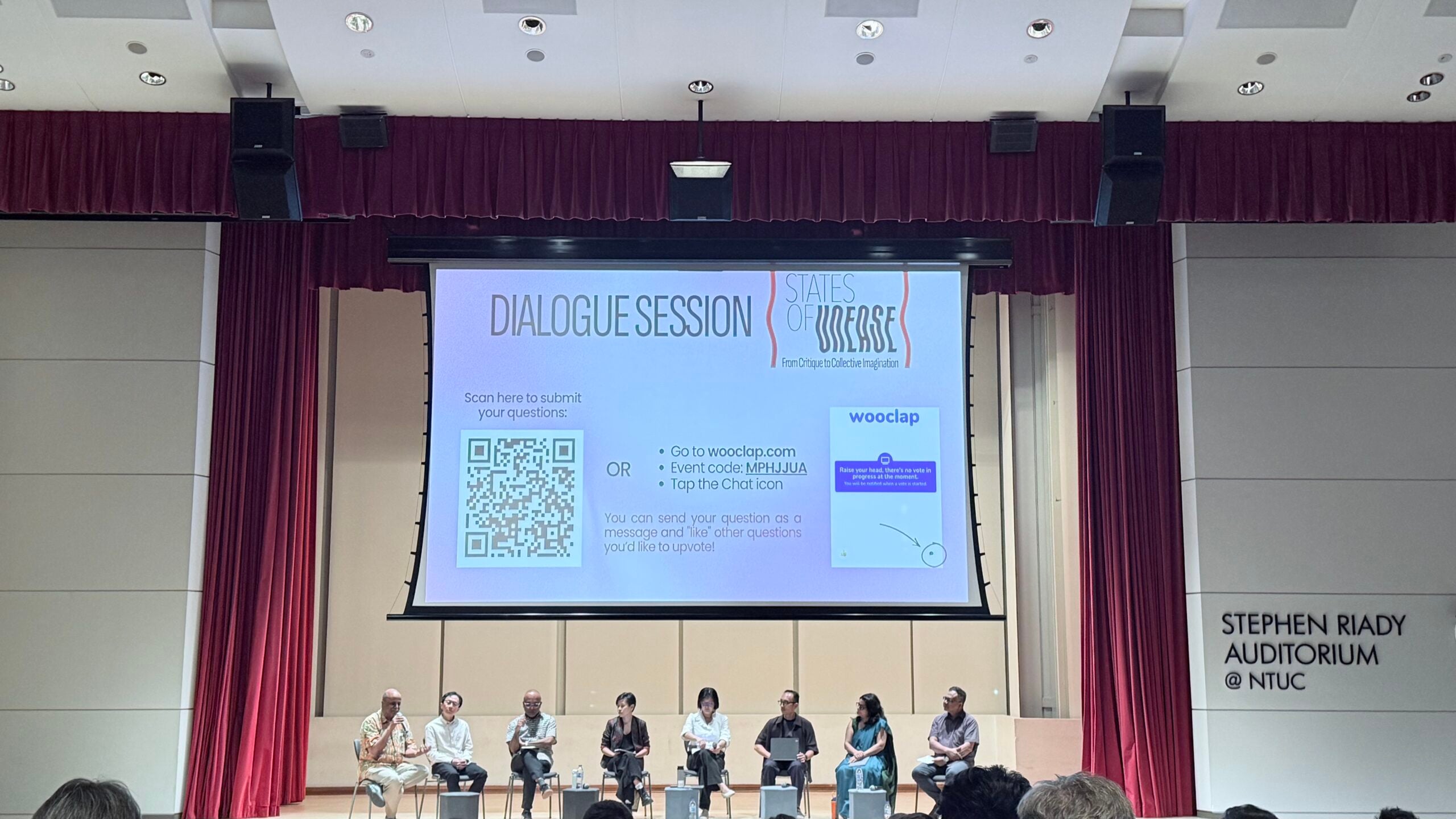
Yesterday, Ethos Books and Academia.sg organized a public forum about You Yenn’s new book, Unease. In the forum, Ng Kok Hoe, researcher from the Lee Kuan Yew School of Public Policy, said something insightful.
I initially started my research thinking, “Maybe the policymakers don’t know. Maybe I just need to let them know.” But then over time, I realised, “They know.” But they say things like “You cannot make things too easy for these people.”
What if harm was as policy designed, and as it was intended?
That led me down the rabbit hole of thinking about the other social policies for the ordinary Singaporeans, and not just those in poverty.
It led me to consider the question,
If we followed the Singapore way (study hard, get educated and ideally a degree, buy a BTO, contribute to your CPF), why doesn’t life seem to still work out?
Might I, the individual, be doing something wrong? Because on the surface, I seemed to be the prime factory product that Singapore wanted to produce.
Good PSLE score. Elite school graduate. Heck, I even graduated with a third language in O Level Japanese. Took an overseas scholarship to the UK.
Yet I struggled to find a job after my first placement, for 2.5 years. Yes you didn’t read that wrong.
It was not months, but years.
At the prime age of 26, I found myself unemployable. Employers told me that my CV looked too good for them, that I would just treat them as a stepping stone. Others said that they could not match the scale of what I wanted to do.
The story I told myself was that these employers simply wanted someone simple to manage. Pliable, malleable.
So I thought, it was just me. I needed to humble myself to get a job to clear my bond. Then I found more like me.
Take James, a NUS student, who started selling insurance for two years, decided that he was not suited, and then later took up SG United courses. SkillsFuture programmes in cybersecurity and tech. After 1 year and 7 months, he finally found a job in materials engineering. But the company abruptly closed, and he found himself back in a short 6-month maternity cover contract, before the MNC shipped most of his department out to Thailand.
Cheaper cost of labour in Thailand. One can’t blame them.
Then another friend and NUS graduate, Titus, worked in HDB for two years, before finding himself ill-suited for bureaucracy. He changed into teaching tuition, a special needs teacher, being an administrator, and now finds himself in a gym, doing digital marketing and customer service for them. At 60% his previous salary.
What was the commonality? They tried to adjust their paths, and found it incredibly hard. Singapore works if you follow the same path for 6 years.
It works with some narrow assumptions and parameters.
- Work the same industry for 6 years.
- Build up your CPF.
- Buy a BTO with that OA in your CPF.
- Climb the corporate ladder.
- In 25 years, you’d have paid off the CPF and have enough to retire.
A walled ecosystem, that stops others from climbing up and out to explore what’s beyond the walled garden
Like Apple, it has an incredibly closed ecosystem that is nearly impermeable to change. This system may have worked before the Digital Age. Now? As the examples above show, it’s harder if you take an exploratory approach in your mid-20s, and find yourself out of a job.
Granted, none of this is unique to Singapore. In many other countries, the 20s are a time of discovery. Yet because of the unique way Singapore’s social policies are set up, I’d argue that this introduces higher switching costs and barriers to people taking their 20s to explore.
For example, in many conversations with friends, when they complain about their jobs, I then ask them,
“Why don’t you change?”
The refrains come fast and furious.
I’ve to pay for my BTO.
Reno started already.
If I change careers, and I got not much savings, how to survive?
Take Titus for example. CPF automatically took 37% of his pay over two years. A $4k job meant a take home of $3.2k. It naturally decreased the amount he could save and put aside for his time now spent exploring different careers. Our social policy ends up hurting a young person’s probability of taking the path of exploration, or shortening how long they can explore for.
I was lucky that in October 2021, when I left my job and started searching for a new one (and would continue searching for the next 2.5 years), I’d already started exploring from April 2020.
I was also helped by the fact that I’d thrown scholarship money into the stock market. Dividends averaged $200/month, but provided a good floor to my earnings.
Living with my parents helped. Eating like a pauper, taking 4 bananas a day to free air-con places to work (libraries, hotel lobbies because they wouldn’t chase you out if you dressed in an Oxford shirt), and eating the free buffets from events definitely helped.
| Date | Skills built | How I got there |
|---|---|---|
| Sep 2018 | Wrote as a student blogger in a UK university for £20 per 1000 word article | Applied for the job |
| Apr 2020 | Made my own website | Had to figure it out |
| Jun 2020 | Started learning to be a trainer by attending ACLP | |
| Jul 2021 | Paid my first $100 by a Singaporean company for writing an article | Met the client (FNS) at ACLP, where we were classmates |
| Jul 2021 | Paid for first training gig by SUSS at $250/h | A charity I’d done a free training for referred me |
| Sep 2021 | Learnt facilitation skills from FNS (and sponsored by them) | |
| Nov 2021 | Did my first facilitation gig for $100 | From FNS |
| Nov 2021 | Started content marketing for clients by writing article for them | Asked everyone I knew to refer me people they knew |
| Sep 2022 | Sold first website build for $1200 | |
| Jul 2023 | Sold first ghostwriting package for $10k | Did lots of SEO to rank first for how to publish and write a book |
| Oct 2023 | Sold first graphic design package for $6500 |
Exploring is worth it
Of course, the common societal expectation is
Why explore?
You’re just wasting time.
Yet consider this. Since the mid-1990s, about half of West Point graduates leave after five years, which is as soon as they are allowed. This is despite them having gotten a 500k scholarship, and having a bright career ahead of them. The people who leave at the lowest rates?
Those who came through officer training whilst at a nonmilitary college. They had to switch into military service.
Build match quality
It suggests that people who optimize for ‘match quality’, coined by economists as the degree of fit between the work someone does and who they are in terms of their ability, end up enjoying their work more.
Yes, optimizing for match quality would mean a healthy amount of switches in one’s early career, but it leads to a more joyful, and I’d argue, a more effective career.
You’d know of the colleague who’s absolutely mediocre at his job, but still checks in daily, because he’s got a mortgage to pay. He’s the undead you don’t want to see.
Some examples:
- They leave promptly at 5pm.
- They don’t volunteer for things that happen outside of work hours.
- They do the bare minimum required for their jobs. They don’t do what’s outside their work scope.
It’s why you see our employee engagement scores lagging at 14%.
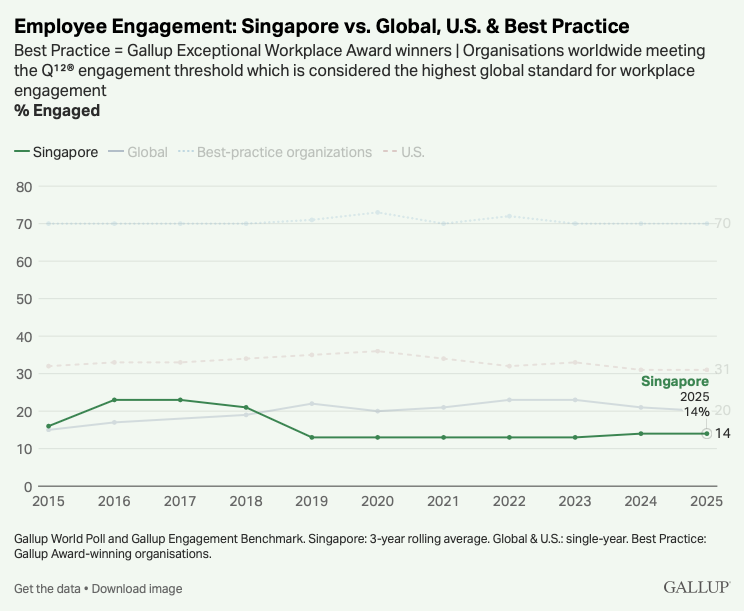
Because a definite recipe for discontent is when you keep employees in their jobs because they have to pay a mortgage for a HDB that is ‘every Singaporeans’ dream’.
But of course, this is not the government’s fault. We ourselves choose to opt into this narrative.
What can we do?
Opt out of the housing narrative
The HDB narrative was by Lee Kuan Yew. He wanted “to give every citizen a stake in the country and its future. (He) wanted a home-owning society.” But what was left unsaid was that HDBs created a sense of rootedness in Singapore. It made people less prone to move.
It locks your freedom.
An entire society keeps saying,
Renting is a waste of money. Why rent when you can buy a house?
We forget that entire societies get by by renting. Home ownership is not a norm.
It’s a desire pushed by the Singapore government, with undoubtedly good intentions, but which we need to be careful about what we’re giving up, in exchange for a hole in the sky.
What is the cost of your freedom?
Trust me, when you’ve a $1800 mortgage you’ve to pay monthly, you’re not going to give up your job to do something else. You’re just going to trudge in and out, whether you like it or not.
Renting gives optionality.
It gives you the option to move from place to place, job to job. It reduces the high switching cost of making a bad career decision. It gives you the chance to adjust.
Home ownership is also much wiser as a mid-stage asset, in your 40s, when you’ve far more liquidity, than as a first asset, when you’ve much, much less.
Think of it this way. At 30, you may have an average of 100k of liquid assets. Why would you put up 80% to downpay for a home, and its accompanying renovation, when the other option of renting is so much wiser?
Rent an entire room for $1500 a month with your wife. Make some babies there. Rinse and repeat. Along the way, if you want a new job, downsize your room.
Scaling up (and down), lightly, is underrated
This ability to scale up and down, in a much lighter way, in a four-figure way, rather than your average $500k flat sale transaction, just seems wiser.
So why do we keep wanting to own a HDB?
Because it seems like it’s the right thing to do. Because everyone else is doing it. Because the government tells us to do it.
Thinking is the hardest thing
At the risk of sounding rude, it’s also because we’re not thinking for ourselves. We’re letting others do the thinking, and accepting it with open arms.
Because if you came to this choice on your own accord, good on you. Pat yourself on the back.
But if you’ve not really thought about it, I’d urge you – please do.
All these complaints about affordability, cost of living, comes because we want what others want for us. If you want a hard asset that expires after 99-years, a hole in the sky, or worse still, you want to let a mortgage guide your life decisions and your joy, be my guest.
I’m saying there’s a choice.
The choice is right there, you might have seen it, but you might just have chosen to ignore it.